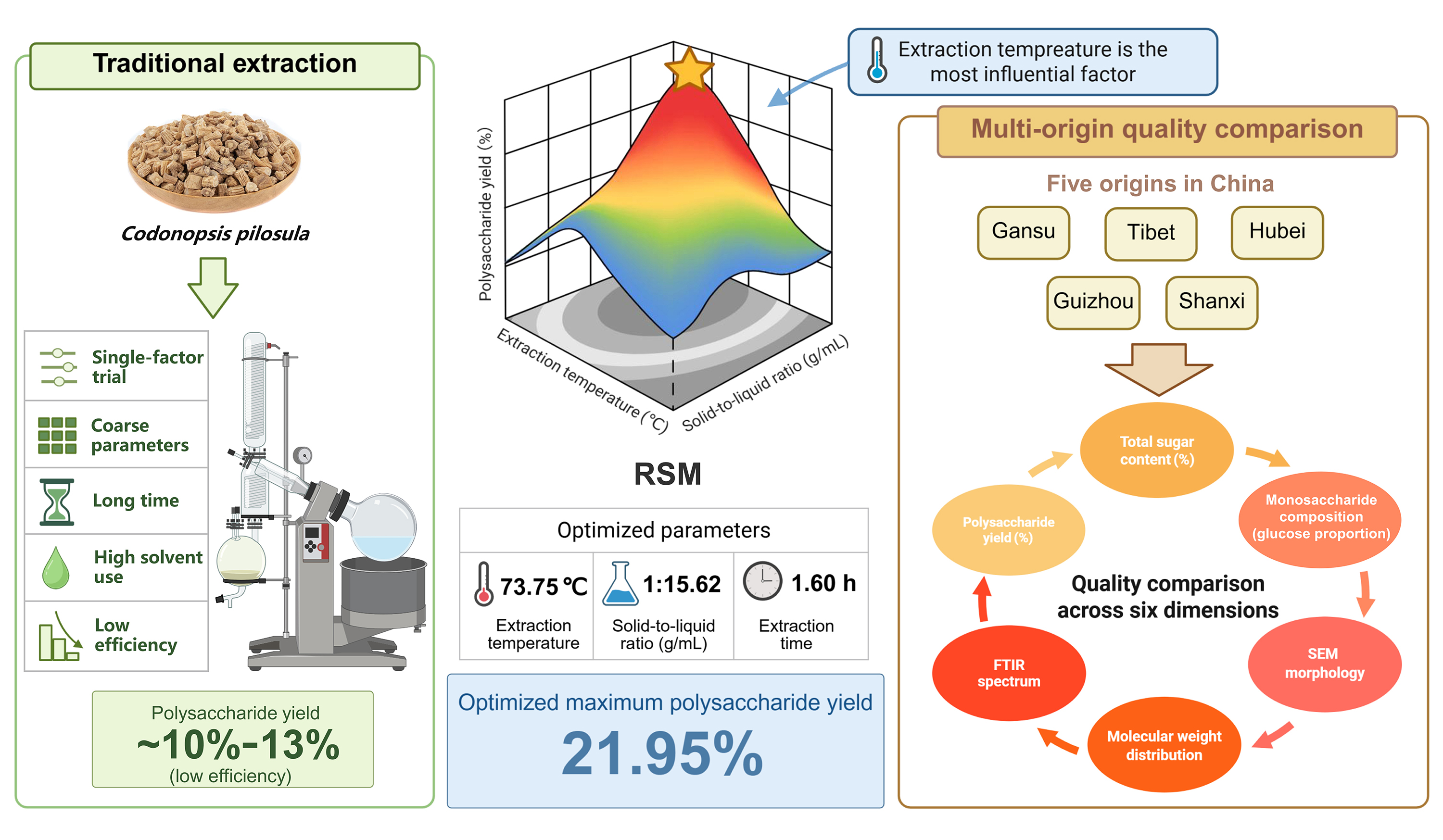
Codonopsis pilosula, a cornerstone of traditional Chinese medicine, owes much of its therapeutic reputation to bioactive polysaccharides. However, inconsistent extraction methods have long hindered both yield and quality assessment. In this study, Zhang and his colleagues employed response surface methodology (RSM) to systematically optimize the extraction process, revealing that temperature exerts the greatest influence on polysaccharide yield. The optimal conditions—73.75?°C, a 1:15.62 (g/mL) ratio, and 1.60?h—achieved a remarkable 21.95% yield, closely matching model predictions.
Beyond process optimization, the team conducted a comprehensive quality comparison of polysaccharides derived from five distinct C. pilosula sources across China: Minxian (Gansu), Enshi (Hubei), Nyingchi (Tibet), Pingshun (Shanxi), and Bijie (Guizhou). Through multi-parameter evaluation—including yield, sugar/protein content, monosaccharide composition, molecular weight distribution, FT-IR spectral fingerprinting, and scanning electron microscopy—Shanxi Pingshun emerged as the superior origin, delivering the highest yield (24.27%). Notably, its polysaccharides featured an exceptionally high glucose proportion (83.25%) and the most uniform particle morphology, suggesting distinct structural and functional advantages.
These findings establish a robust, reproducible extraction protocol while highlighting how geographical and environmental factors profoundly shape polysaccharide quality. The study provides a critical reference for standardizing Codonopsis quality control and guiding the selection of optimal raw material sources for pharmaceutical and functional applications.
Han, R. et al. / J. Chin. Pharm. Sci. 2026, 35 (7), 601–614.


 >
> >
>