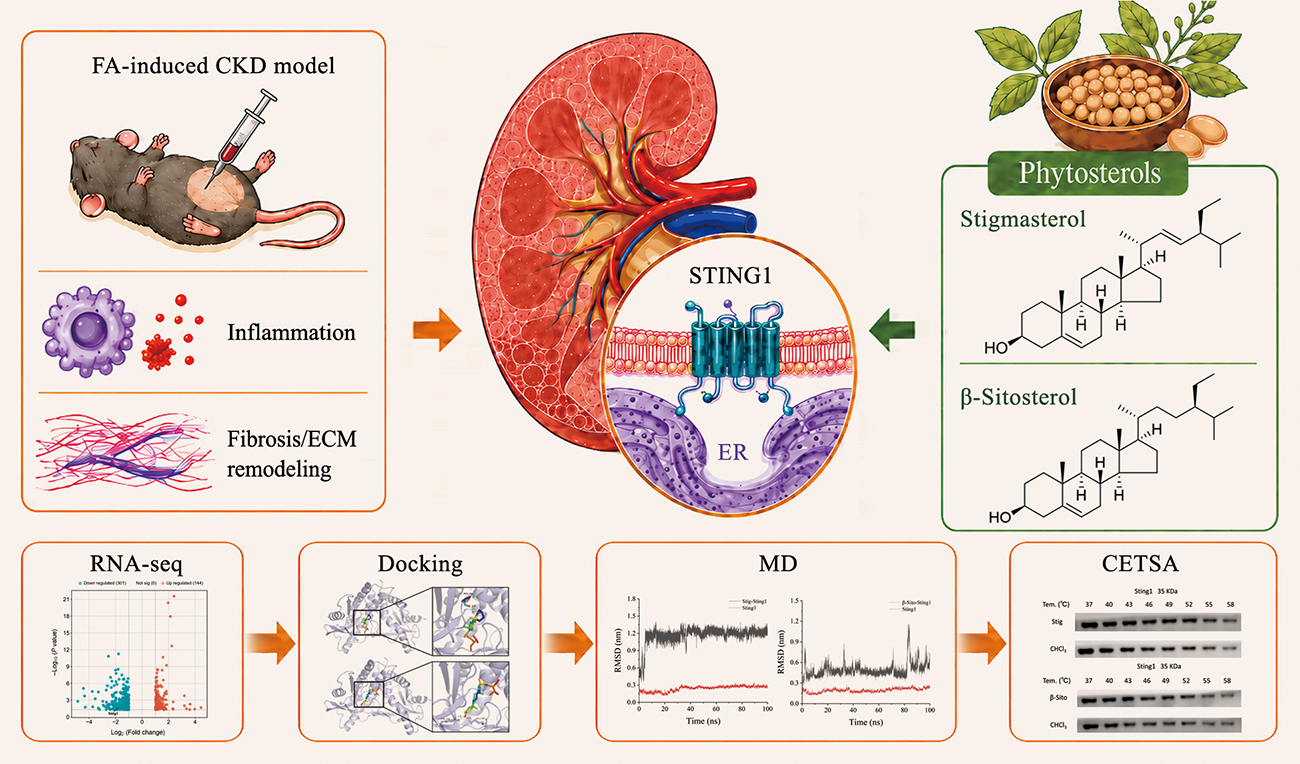
Chronic kidney disease (CKD) is predominantly characterized by sustained renal inflammation, progressive fibrosis, and remodeling of the extracellular matrix (ECM). The cover of this issue features a study investigating the therapeutic mechanisms of phytosterols, specifically stigmasterol and β-sitosterol, in the context of CKD. Employing a folic acid (FA)-induced CKD animal model, the research team conducted transcriptomic analysis (RNA-seq) to identify differentially expressed genes, pinpointing STING1, a transmembrane protein located on the endoplasmic reticulum, as a critical target. The study subsequently concentrated on elucidating the direct interaction between the phytosterols and STING1. Through the application of molecular docking, molecular dynamics (MD) simulations, and the cellular thermal shift assay (CETSA), it was conclusively demonstrated that these plant-derived sterols can establish stable and direct interactions with the STING1 protein. Overall, this research illustrates that phytosterols, namely stigmasterol and β-sitosterol, can bind to and stabilize the STING1 protein, thereby mitigating its overactivation in the CKD model and conferring multiple renoprotective effects, including anti-inflammatory and tissue-protective actions.
Li, R. et al. / J. Chin. Pharm. Sci. 2026, 35 (5), 407–419.



 >
> >
>